Vol.3, No.2
Kaziranga National Park: Golden Moments of Conservation History of Assam Wild Heritage
Hirendra Nath Sarma
Editor-in-Chief
Email: hirendra.sarma@rgu.ac.in
Kaziranga, a place of central zone of Assam at the heart of Brahmaputra River. The history of the name Kaziranga (Kazi and Ranga) is only centuries old associated with various legends, while, this place has been recorded as billions of years as old as Mount Himalaya and Brahmaputra river. The Brahmaputra River, is one of the greatest river systems of the world established the human civilization thousands years back. The mighty river created the Brahmaputra valley along with its catchment basin surrounded by the Himalayan mountain range. Over the years, name has been assigned in different range of this mountain, areas of Brahmaputra basin while the nature remains same with its endemic flora fauna .
Kaziranga is a unique ecosystem linked with the lotic and lentic water system of river Brahmaputra. During summer, the whole Kaziranga is inundated by flood water washing out by flowing water from east to west. During winter, it creates the water bodies: "beel", swamp, sand dunes (Chapories), grass lands all of which are interlinked by the river tributaries. World's largest river island "the Majuli" is attached naturally and biologically with Kaziranga . An umpteen numbers of endemic species, the Kaziranga is home land of aquatic, terrestrial and avian fauna. By and large Kaziranga is famous and known across the world for One horned Rhinoceros and Royal Bengal Tigers. History of Rhinoceros in Kaziranga could be older than the human civilization in Brahmaputra valley. Along with the Rhinoceros, thousands of species of flora and fauna that have been evolved in this zone of eastern part of Mount Himalalaya and the heart of Brahmaputra river.
Kaziranga started it political history with recognition as reserve forest by Government way back of more than one hundred years in the year 1905. It grows continuously; over the decades, recognized as National Park by the Government of Assam in the year 1969. Today in 21st century, the Assam, one of the states of north eastern region of Indian Subcontinent has been glittered with Kaziranga National Park for nature conservation.
The Kaziranga National park is celebrating fifty years of its glorious history of existence for wildlife conservation. This year, the Government of Assam declared the celebration of Golden Jubilee on its successful fifty years of modern history of existence as National Park. Home of thousands of endemic species this National Park is proud of growth and development of every issues of nature conservation. Credit goes to the people of Assam who by mind and hearts show the affection to the wild life and conserved it for posterity. By the people's support and enthusiasm, the Kaziranga has been growing in its area year after year.
Kaziranga National Park is one of the world's best natural laboratories for study of conservation of ecosystem, flora and fauna in situ. The impact of global climate change could have its effects on this virgin ecosystem. An integrated multidisciplinary research is the call of the present moment for sustainable development of this unique ecosystem of sub Himalayan region.
Political patronization is an important issue and inevitable for conservation of any ecological system of the world. States in the 21st century being run by the Government, thus need legal protection of the ecosystem as well as wildlife conservation. An integrated approach of scientists for analysis of conservation issues of flora fauna, abiotic components, social workers for building awareness on need of conservation among masses and governmental organization for legal protection and management could be considered as the primary requirement of successful conservation and its sustainable development. It is believed, Kaziranga National Park has been growing with its healthy sustainable developmental process that has been attracting the international tourists to enjoy the tapestry of nature of Brahmaputra valley. People of Assam are proud of Kaziranga today and stand forward in front of the world community showing the best model of nature and wildlife conservation for posterity.
Reference : Ghosh S. Glorius 50 years of Kaziranga. Assam Tribune, 11 February, 2024
Abstract: Though the medical sciences have made enormous advances, plants are still considered as a potential source of drugs for treating various diseases worldwide.Plants are used extensively for the treatment of different health conditions with a high rate of recovery. The present study on ethnobotany was carried out to identify the plants and their parts that are used for the treatment of snakebite by the tribal population of Jhargram district. The study was conducted by taking interviews of the knowledgeable informants like tribal medical practitioners, elderly members of the tribal community and house-wives with structured questionnaire in the remote places of the district. The study investigated and listed 43 plants that are commonly used for snakebite treatment. Among them, herbs are dominated followed by trees, climbers, shrubs and grass. There are total 29 families, out of which 23 families were dicotyledons and 6 families belong to monocotyledons. This ethnobotanical study mainly emphasized on the documentation of those plants which are used for snakebite treatment and found it important for future use. The study may also influence other pharmacologists, ethno botanists and phytochemists for further extensive studies on medicinal plants used by tribal people of different parts of West Bengal.
Keywords: Ethnobotany, Knowledgeable informants.Medicinal plants,Snakebite, Traditional knowledge
Abstract: Though the medical sciences have made enormous advances, plants are still considered as a potential source of drugs for treating various diseases worldwide.Plants are used extensively for the treatment of different health conditions with a high rate of recovery. The present study on ethnobotany was carried out to identify the plants and their parts that are used for the treatment of snakebite by the tribal population of Jhargram district. The study was conducted by taking interviews of the knowledgeable informants like tribal medical practitioners, elderly members of the tribal community and house-wives with structured questionnaire in the remote places of the district. The study investigated and listed 43 plants that are commonly used for snakebite treatment. Among them, herbs are dominated followed by trees, climbers, shrubs and grass. There are total 29 families, out of which 23 families were dicotyledons and 6 families belong to monocotyledons. This ethnobotanical study mainly emphasized on the documentation of those plants which are used for snakebite treatment and found it important for future use. The study may also influence other pharmacologists, ethno botanists and phytochemists for further extensive studies on medicinal plants used by tribal people of different parts of West Bengal.
Keywords: Ethnobotany, Knowledgeable informants.Medicinal plants,Snakebite, Traditional knowledge
Abstract: This research focuses on the screening, identification and evaluation of cellulolytic activity exhibited by different species of Chaetomium, a filamentous fungus known for its diverse enzymatic capabilities. Cellulose, a complex polysaccharide found in plant cell walls, is a promising feedstock for bioenergy and biorefinery applications. Different microorganisms, especially filamentous fungi, play an important role in the breakdown of cellulose using cellulase enzymes.The fungal cellulase ismore thermostable that makes them a better choice for industrial applications.During collection of deteriorated cellulosic samples,9 different genera of fungi were encountered. Among them the most dominant was Chaetomium with35 different species. These species were evaluated for their cellulolytic activities.The occurrence of several species of Chaetomium in the survey prompted further investigation of relatively less studied species.This evaluation was carried out based ondetermination of the cellulolytic activity in terms of loss in weight of filter paper followed by enzyme assays viz., determination of extracellular enzyme activities with respect to exoglucanase andendoglucanase activities of 10 selected species (which showed more than 25% loss in weight of filter paper) viz., C. globosum, C. mollicellum, C. subspirale, C. olivaceum,C. convolutum, C. fibripilum, C. cochliodes, C. erraticum, C. Brasiliense and C. senegalensis . C. cochliodes showed maximum cellulolytic activity in terms of loss in weight of filter paper where as C. Subspirale recoded maximum activities for both exoglucanase and endoglucanase enzymes. C. olivaceum exhibited least activities in both the cases. The findings contribute to the understanding of Chaetomium as a valuable cellulolytic resource for sustainable bioprocessing.
Keywords: Chaetomium , cellulolytic enzymes, cellulose, endoglucanase, exoglucanase, fungi
Abstract: Agnihotra is an important practice of Vedic period which is performed for peace, happiness and prosperity. During ancient age, it was performed many times in a day by the Vedic people. Agnihotra was an important part of their routine life. Fumes of Yagya purify the surrounding environment by removing foul odors replaced with various volatile organic compounds. But in the modern time it is performed only on some special occasions like ceremonies, festivals and on other worships. Ancient time people were uses various medicinal plants for curing harmful diseases by performing fumigation method. Present study is focused on the medicinal plants which are applied to perform a very ancient religious practice of the Kumaun Himalaya and effect of their components when offered in Agnihotra as Havan material or their medicinal uses. A questionnairebased survey was conducted in major religious places of Almora for collecting the information on plants used in the worship on different occasions. In result a total of 34 medicinal plants are recorded from four major religious sports of Kumaun. Out of which maximum 24 plants are applied in the worship of lord Shiva at Jageshwar shrine. Apart from this, 29 such medicinal plants along with their chemical constituents have also been studied which are mentioned in the Vedic text and these are applied in Agnihotra . This study will be important in preserving this plant-based Vedic practice of Kumaun as well as these important medicinal plants and an attempt has also been made to emphasize the plants which are used in making incense and Havan material.
Keywords: Medicinal plants, Vedic rituals (Agnihotra) , common diseases, volatile component, major religious spots of Kumaun
Abstract: Agnihotra is an important practice of Vedic period which is performed for peace, happiness and prosperity. During ancient age, it was performed many times in a day by the Vedic people. Agnihotra was an important part of their routine life. Fumes of Yagya purify the surrounding environment by removing foul odors replaced with various volatile organic compounds. But in the modern time it is performed only on some special occasions like ceremonies, festivals and on other worships. Ancient time people were uses various medicinal plants for curing harmful diseases by performing fumigation method. Present study is focused on the medicinal plants which are applied to perform a very ancient religious practice of the Kumaun Himalaya and effect of their components when offered in Agnihotra as Havan material or their medicinal uses. A questionnairebased survey was conducted in major religious places of Almora for collecting the information on plants used in the worship on different occasions. In result a total of 34 medicinal plants are recorded from four major religious sports of Kumaun. Out of which maximum 24 plants are applied in the worship of lord Shiva at Jageshwar shrine. Apart from this, 29 such medicinal plants along with their chemical constituents have also been studied which are mentioned in the Vedic text and these are applied in Agnihotra . This study will be important in preserving this plant-based Vedic practice of Kumaun as well as these important medicinal plants and an attempt has also been made to emphasize the plants which are used in making incense and Havan material.
Keywords: Medicinal plants, Vedic rituals (Agnihotra) , common diseases, volatile component, major religious spots of Kumaun
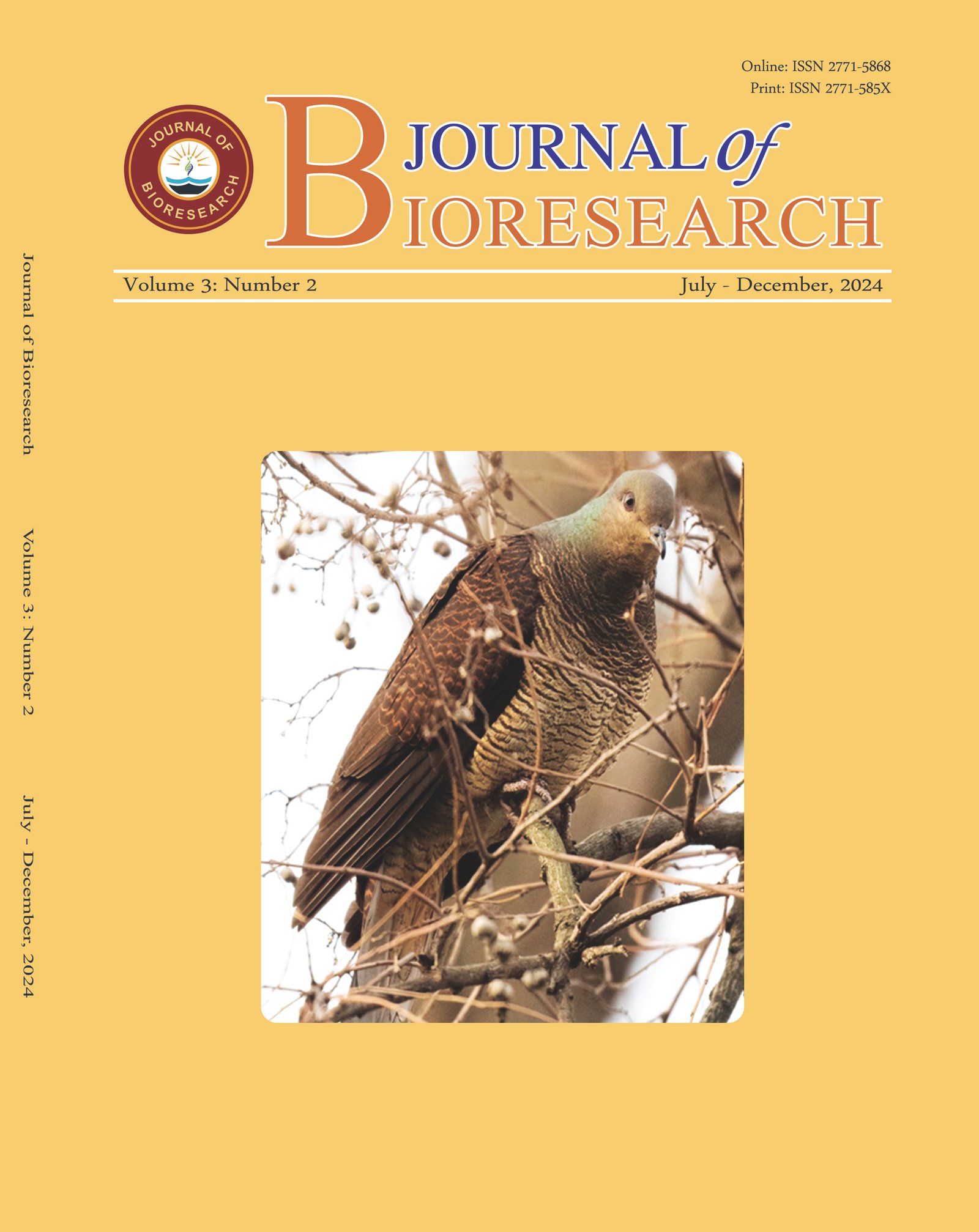
Abstract: Barred cuckoo-dove is a species of bird which is native to South and Southeast Asia. It belongs to the family Columbidae and is listed under Least Concern category in the IUCN Red List. This species is sexually dimorphic. Males have unbarred head and neck with extensive purple and green gloss. Females are heavily barred on head, neck and underparts with gloss which are restricted to nape and side of neck. We recorded Barred cuckoo-dove Macropygia unchall in a commercial area of district head quarter town, Kokrajhar incidentally as part of a routine survey. Generally a forest bird species,a total ofnine individuals were seen perching on the tin roof of an old concrete house, covered under the moderately dense canopy of Eucalyptus tree Eucalyptus globules . As birds are regarded as the biological indicator which signifies the health of the ecosystem, it is important to preserve the existence of any species of wild birds that are present around us.
Keywords: Commercial, dove, forest, habitat, monsoon season, Urban
Abstract: Barred cuckoo-dove is a species of bird which is native to South and Southeast Asia. It belongs to the family Columbidae and is listed under Least Concern category in the IUCN Red List. This species is sexually dimorphic. Males have unbarred head and neck with extensive purple and green gloss. Females are heavily barred on head, neck and underparts with gloss which are restricted to nape and side of neck. We recorded Barred cuckoo-dove Macropygia unchall in a commercial area of district head quarter town, Kokrajhar incidentally as part of a routine survey. Generally a forest bird species,a total ofnine individuals were seen perching on the tin roof of an old concrete house, covered under the moderately dense canopy of Eucalyptus tree Eucalyptus globules . As birds are regarded as the biological indicator which signifies the health of the ecosystem, it is important to preserve the existence of any species of wild birds that are present around us.
Keywords: Commercial, dove, forest, habitat, monsoon season, Urban