Vol.2, No.1
Tribute to Prof. Hari Chandra Mahanta: A Genius in Teaching and Research of Zoological Science in North East India
Hirendra Nath Sarma
Editor-in-Chief
Email: hirendra.sarma@rgu.ac.in
Prof. Hari Chandra Mahanta (1942 - 2022) established himself as genius in the research and teaching of Zoological Science in Assam. Among the academicians, researchers, scientific community he was known as HC Mahanta of Zoology Department of Gauhati University. Born in a unique place, the biggest river island of the world named "Majuli" at the heart of mighty River Brahmaputra, he grew up in the Vaishnavite Satra. Satra's thought of purity, truthfulness, sincerity, devotion and dedication for duty and responsibility has been inherited from his great parents and continued for whole life. It has been reflected in his life as a teacher, researcher and administrator during his long career of teaching and research in Gauhati University from 1966 to 2002. He pursued higher Education in Cotton College of Guwahati and then obtained Masters Degree from the Zoology Department of Gauhati University in the year 1965. Due to his brilliant academic career, Mahanta was offered the post of Lecturer of Zoology in Gauhati University, and joined the Department of Zoology of this prestigious University of Assam in the year 1966. Mahanta moved to Leningrade University (Present Saint Petersburg State University, Russia) of erstwhile USSR for doctoral research in the year 1969. He had been selected as one of best fifteen candidates of India for the Indo-USSR fellowship for doctoral research. A dedicated and hard working researcher, Mahanta obtained PhD degree in Insect Neurophysiology and came back to motherland in the year 1973. During this tenure he learned the Russian language and prepared the doctoral thesis in this foreign language only. Well known in the scientific community of India and abroad, HC Mahanta is famous for his expertise in insect biochemistry at the beginning of his research career. He produced more than a dozen of Doctoral students under his supervision from University as well as other organization of Government of India like Defense Research and Development Organization, Central Silk Board etc. Owed to his diverse interest of teaching and research, Prof. H C Mahanta established a new area of research in Animal Physiology and Biochemistry and Reproductive Physiology in the Department of Zoology, GU. From his laboratory, he established himself as a pioneer in the field of research on plant derived biomolecules, it's in vivo validation for drug development. It is Due to his non conventional innovative thinking, in vivo testing of traditional herbal medicines prevailed in Assam has been started in the Zoology Department of GU in the last decade of 20th century. It has been accredited and recognized with high quality International research publications. Prof. HC Mahanta's courageous approach of introducing new area of research in Zoology and establishing laboratory with sophistication of his time was the greatest achievement of research and teaching in north east India. His training to the doctoral researchers on innovative ideas of science created brilliant students who served in various capacities in the University of India and abroad. Prof. HC Mahanta for his visionary thought, understanding the need of technologies in finding solutions to the scientific problems makes himself genius among scientific communities. He made friends within the country and abroad and able to create an International forum of research through his own laboratory of Gauhati University.
Hirendra Nath Sarma
Professor of Zoology, Rajiv Gandhi University
Arunachal Pradesh - 791 112, India
Phone : +91 94360 59038
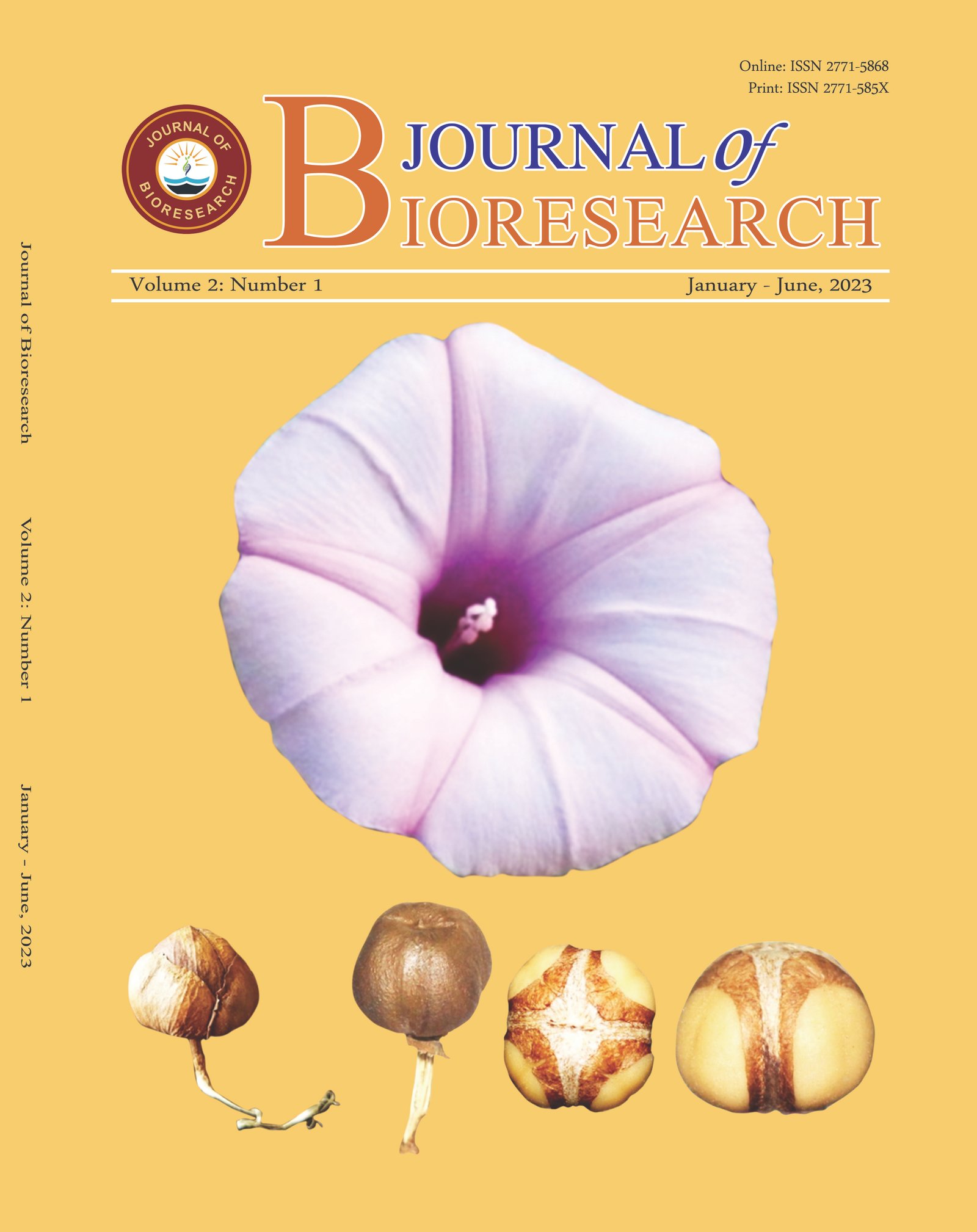
Abstract: The genus Stictocardia Hallier f. which is known for its characterized black glands on lower leaf surface and distinctive fruit nature is represented by three species in India. The present paper describes the new distribution record and rare habitat of Stictocardia tiliifolia from Kankeshwar Alibag. The species S. tiliifolia is always under controversy for its nomenclature, the present paper thus provides detail taxonomic description along with photographs and relevant notes for its easy identification in field. The species S. tiliifolia is mostly mistaken as S. beraviensis; the former can be easily distinguished by its whitish-pinkish to purple corolla. The study area Kankeshwar is rich is biodiversity though least explored, such field studies will definitely add more data to flora of Alibag.
Keywords: Convolvulaceae, fruits, habitat, Kankeshwar, rare, Stictocardia tiliifolia
Abstract: Despite being located at the confluence of two biodiversity hotspots – the Himalaya and the Indo-Burma – our knowledge on the diversity of longhorn beetle from Northeast India is very limited and account for about a third of the total Indian diversity. Herein, we are reporting a confirmed record of Dorysthenes (Lophosternus) huegelii from Assam, India. A discussion on the limitation on the knowledge of the confirmed distribution range of this species in India based on historical records is also made. Being an economic pest, the knowledge on the distribution of the tree root borer D (L.) huegelii plays an important role in economic pest management. Taxonomic keys to the species under this genus recorded from India is also added.
Keywords: Dhemaji, distribution record, longhorn beetles, northeast India, taxonomic keys, undivided Assam
Abstract: During 2012–2018, a survey was conducted for the protozoan parasites in valley districts of Manipur. Cockroaches were collected using Sweep-netting methods and dissected. Fresh and permanent slides of collected protozoa from the gut; the sample insect were prepared using Haedenhain's iron, haematoxylin, Giemsa and Eosin stains. Mean, standard deviation and percent of co-efficient of variations are calculated. Two new Eugregarine protozoans namely, Phleobum periplanae sp. nov and Neohirmorcystis canchipurae sp. nov. were revealed new to science. Only 9 species of Phleobum protozoa has been identified so far. The present study added a new species to this group of protozoa. Phleobum periplanae sp. nov. is characterized by spherical epimerite which measures 14.7 – 32.6 µm while the protomerite is broadly ovoid, covered by a thick pellicle which measure 26.9 – 56.9 µm. Fresh gametocytes are yellowish- orange and ellipsoidal. A new species of Neohirmocystis is described here. Only a few species of Neohirmocystis protozoa have been identified. Neohirmocystis canchipurae sp. nov. is characterised by lack of epimerites with atrophozoite length of (159.6-192.6) µm. Gametocyst dehisces by simple rupture releasing spherical spores.
Keywords: Didymophyidae, Neohirmocystidae and Periplanata americana
Abstract: During 2012–2018, a survey was conducted for the protozoan parasites in valley districts of Manipur. Cockroaches were collected using Sweep-netting methods and dissected. Fresh and permanent slides of collected protozoa from the gut; the sample insect were prepared using Haedenhain's iron, haematoxylin, Giemsa and Eosin stains. Mean, standard deviation and percent of co-efficient of variations are calculated. Two new Eugregarine protozoans namely, Phleobum periplanae sp. nov and Neohirmorcystis canchipurae sp. nov. were revealed new to science. Only 9 species of Phleobum protozoa has been identified so far. The present study added a new species to this group of protozoa. Phleobum periplanae sp. nov. is characterized by spherical epimerite which measures 14.7 – 32.6 µm while the protomerite is broadly ovoid, covered by a thick pellicle which measure 26.9 – 56.9 µm. Fresh gametocytes are yellowish- orange and ellipsoidal. A new species of Neohirmocystis is described here. Only a few species of Neohirmocystis protozoa have been identified. Neohirmocystis canchipurae sp. nov. is characterised by lack of epimerites with atrophozoite length of (159.6-192.6) µm. Gametocyst dehisces by simple rupture releasing spherical spores.
Keywords: Didymophyidae, Neohirmocystidae and Periplanata americana
Abstract: Basella rubra Linn belongs to the family Basellaceae. The people of Manipur have been using plants as indigenous colorants before introducing synthetic colorants in Manipur. In addition traditional natural dyes plants were extinct their exploitation due to unavailability of indigenous knowledge on extracting and dying techniques. Natural dyes are environmental friendly although synthetic dyes rapidly replaced the traditional natural dyes because of availability, cost less, a vast range of new colors and imparted better properties to the dyed materials. Present circumstances, the use of natural dyes has fall-off due to lack of documentation. The traditionally used dye plants Achyranthus aspera and Basella rubra linn of Manipur were investigated for edible herbal pigment and vegetable dyes. Achyranthus aspera is used as natural mordant were as chemical analysis was not done. The chemical analyses of the bioactive compounds present in selected plant Basella rubra were characterized by NMR: (1H NMR, 13C NMR, and DEPT-135 NMR), TLC, UV-Vis, IR, Column Chromatography, LC-MS, profiles were recorded for evaluating the products and identification of the compound. Compound 1,2,3,4 and 5 were isolated by column chromatography from Basella rubra linn. Only compound 4 (3, 5-Bis-aminomethyl-cyclohexanone) and compound 5 (3-(2-Amino-ethyl)-2-aminomethyl-4-ethyl-cyclopentylamine) were identified and not reported before. Purple, red, green and brown pigments which are food grade are separated and characterized.
Keywords: Achyranthus aspera, Basella rubra, Meitei Community, Manipur, Traditional dye
Abstract: Tropical tasar or Antheraea mylitta is a commercially important non-mulberry silkworm that produces the world famous Indian tropical tasar silk. So far forty-four ecoraces of the species have been reported from different states of India. In West Bengal, previously it had been recorded from the Southern part including Kolkata and the hill region of North Bengal. In June 2020, two beautifully coloured, large-sized male and female tasar moths, a mature tasar worm and an emerged tasar cocoon is observed on the Ber plant or Indian jujube plant (Ziziphus mauritiana Lam.) a secondary food plant of tasar silkworm near Farabari, Siliguri subdivision of Terai agro-ecological zone, West Bengal. This new record updates the present distribution of tasar moth in West Bengal. An attempt has been made in the present work to report the existence of Antheraea mylitta Drury along with photographs from Terai region, West Bengal, India. During the investigation, length and breadth with wing expanded of female and male tasar moth measured about 6cm, 15.4cm and 5.3cm, 14cm respectively. The mature larva was 10.1cm in length, 2.3cm in width and 30.62g in weight. The colour of emerged cocoon was grayish brown, having a shell weight of 1.62g. Based on the present report, further investigation may be carried out in the future to identify the ecorace along with its economic importance in Sericulture.
Keywords: Antheraea mylitta, Tasar Silkmoth, Sericulture
Abstract: Tropical tasar or Antheraea mylitta is a commercially important non-mulberry silkworm that produces the world famous Indian tropical tasar silk. So far forty-four ecoraces of the species have been reported from different states of India. In West Bengal, previously it had been recorded from the Southern part including Kolkata and the hill region of North Bengal. In June 2020, two beautifully coloured, large-sized male and female tasar moths, a mature tasar worm and an emerged tasar cocoon is observed on the Ber plant or Indian jujube plant (Ziziphus mauritiana Lam.) a secondary food plant of tasar silkworm near Farabari, Siliguri subdivision of Terai agro-ecological zone, West Bengal. This new record updates the present distribution of tasar moth in West Bengal. An attempt has been made in the present work to report the existence of Antheraea mylitta Drury along with photographs from Terai region, West Bengal, India. During the investigation, length and breadth with wing expanded of female and male tasar moth measured about 6cm, 15.4cm and 5.3cm, 14cm respectively. The mature larva was 10.1cm in length, 2.3cm in width and 30.62g in weight. The colour of emerged cocoon was grayish brown, having a shell weight of 1.62g. Based on the present report, further investigation may be carried out in the future to identify the ecorace along with its economic importance in Sericulture.
Keywords: Antheraea mylitta, Tasar Silkmoth, Sericulture