Vol.4, No.2
A Nobel Prize on Traditional Medicine in 21st Century: Need a new look on Indian Medicnal plants.
Hirendra Nath Sarma
Editor-in-Chief
Email: hirendra.sarma@rgu.ac.in
When the western medicines ruled over the pharmaceutical products, that is when the synthetic compounds engulfed the market, Tu Youyou from China was awarded the Nobel Prize in the year 2015 in Medicine and Physiology for the discovery of the antimalarial drug "Artemisinin" from the herb Artemisia. It is not only one of the major breakthroughs of scientific discovery in the 21st century, but also a changing thought of science on natural products. Tu Youyou's Nobel Prize has drawn the attention of the world community to the rich storage of medicinal plants in the Global South. India, which has thousands of years of glorious golden script on herbal preparations, even as life-saving drugs, turns into a new momentum of medicine and human health research. The medicinal plant Artemisia has been known for medicinal use in India for years too. The tribal communities of the eastern part of Arunachal Pradesh (Tirap, Londing, and Anjaw districts) have been using this plant for the prevention of malaria for centuries. This indigenous knowledge is as old as their social existence, languages that have been continuing as folklore and being passed on from generation to generation. Probably, nobody from India came forward with such dedication even during the post-independence period to look for such precious materials of North East India in search of a gift to humanity. Some of the medicinal plants being used by the people of North East India are: Coptees teeta, caterpillar fungus, Dysozyllum alliarium, Ashoka plant (Saraca indica), Andrographis paniculata, Polygonum hydropiper, Plumbago rosea, Cynoglossum zeylanicum, Lasia spinosa and many more. Some are very common, while others are used to treat specific health disorders after proper diagnosis. It is believed that a proper approach to biomedical research of these natural resources shall yield results, which will benefit the mankind of the world. The ancient literature never described the mode of molecular mechanism of action of this plant extract. Modern scientific thoughts believe on how and why of a particular medicine. The modern scientists in laboratory get blind looking at its mechanism of action in the target tissue. Where should we go… ? We will get new window of discovery of system biology and cross talk of cellular components. How the natural products from plants interact with various molecular components of cells and signal for final regulation of cell functions in proper track. India never had lack of talents for such discovery, however,there is a need to find out the reason for the failure of thecause. There are hundreds of medicinal plants mentioned in various thousands of years old ancient Indian literature for medicinal use. The Government of India has established the Ministry of Ayush to foster Indian Medicines and its practices as well as promote learning and research on various Indian traditional medicine systems like Ayurveda, Siddha, Unani where extensive herbal medicines are being used. Present day scientists' self confidence, dedication and a proper forum for execution of the research could be the primary requirements for such epoch making discovery in any country of the world. Scientists need their freedom of thought and process of execution. Government of India's New Education Policy has brought the advantages for the young researchers to start their research carrier at an early stage of academic career. For the young researchers, job security and financial strength at base is the priority to settle them in life. Whenever, such an environment is created in any institution, an excellent research outcome is inevitable.
Abstract: The growing demand for sustainable energy sources in the aviation industry has spurred interest in alternative biofuels. The algal exopolysaccharides (EPS) have emerged as a promising candidate for jet fuel production. This paper explores the potential of algal EPS as a sustainable and eco-friendly alternative to conventional jet fuels. Algal EPS offer several advantages, including their renewability, low environmental impact, and compatibility with existing jet engine technologies. Additionally, their carbon-neutral cycle, efficient water usage and ability to be cultivated on non-arable land make them an ideal source for biofuel production. The chemical properties of algal EPS can be tailored to meet the specific requirements of jet fuels, ensuring high performance, low emissions and efficient combustion. This paper discusses the potential environmental and economic benefits of EPS-derived biofuels, including their role in reducing greenhouse gas emissions, improving energy security and creating new industries. The integration of algae cultivation with wastewater treatment systems further enhances the feasibility of algal EPS as a biofuel feedstock. The paper concludes by emphasizing the significance of further research and technological advancements in making EPS-based jet fuels a viable solution for sustainable aviation fuel production.
Keywords: Aviation, Biofuel, Exopolysaccharides, Nutrient Cycling
Abstract: The excessive reliance on plastic in the $104.2 billion global toy industry has led to severe environmental concerns, with 90% of toys being plastic-based and 80% ultimately discarded in landfills, where they persist for up to 500 years. Addressing this issue, this study investigates the potential of sugarcane bagasse (SCB), an abundant agricultural by-product in India, and mycelium as biodegradable alternatives for toy manufacturing. With India producing over 500 million metric tons of sugarcane annually—resulting in nearly 100 million metric tons of SCB—repurposing this waste could contribute to sustainable material development. To evaluate SCB's viability, four substrate forms—fine, coarse, ashed, and filter mud—were prepared and inoculated with mycelium spores. Incubation occurred under controlled conditions (25–27°C, 25–30 days), followed by prototype formation in pin and ball molds and drying at 40°C for stability. The study assessed mycelium colonization, structural integrity, shrinkage control, dye absorption, and aroma infusion. Findings revealed that coarse SCB exhibited the highest colonization efficiency, with fine SCB supporting moderate growth, while ashed SCB and filter mud showed limited compatibility. Developed prototypes demonstrated 88% structural integrity, 93% shrinkage control, and 80% durability. Natural dyeing with turmeric and onion peels was effective, whereas aroma infusion yielded inconclusive results. By offering a viable, biodegradable alternative to plastic toys, this research promotes circular economy principles and waste valorization. Further exploration of material properties, large-scale production, and commercialization is essential for industry adoption.
Keywords: Bio-composite material, Mycelium, Sugarcane Bagasse (SCB)
Abstract: The excessive reliance on plastic in the $104.2 billion global toy industry has led to severe environmental concerns, with 90% of toys being plastic-based and 80% ultimately discarded in landfills, where they persist for up to 500 years. Addressing this issue, this study investigates the potential of sugarcane bagasse (SCB), an abundant agricultural by-product in India, and mycelium as biodegradable alternatives for toy manufacturing. With India producing over 500 million metric tons of sugarcane annually—resulting in nearly 100 million metric tons of SCB—repurposing this waste could contribute to sustainable material development. To evaluate SCB's viability, four substrate forms—fine, coarse, ashed, and filter mud—were prepared and inoculated with mycelium spores. Incubation occurred under controlled conditions (25–27°C, 25–30 days), followed by prototype formation in pin and ball molds and drying at 40°C for stability. The study assessed mycelium colonization, structural integrity, shrinkage control, dye absorption, and aroma infusion. Findings revealed that coarse SCB exhibited the highest colonization efficiency, with fine SCB supporting moderate growth, while ashed SCB and filter mud showed limited compatibility. Developed prototypes demonstrated 88% structural integrity, 93% shrinkage control, and 80% durability. Natural dyeing with turmeric and onion peels was effective, whereas aroma infusion yielded inconclusive results. By offering a viable, biodegradable alternative to plastic toys, this research promotes circular economy principles and waste valorization. Further exploration of material properties, large-scale production, and commercialization is essential for industry adoption.
Keywords: Bio-composite material, Mycelium, Sugarcane Bagasse (SCB)
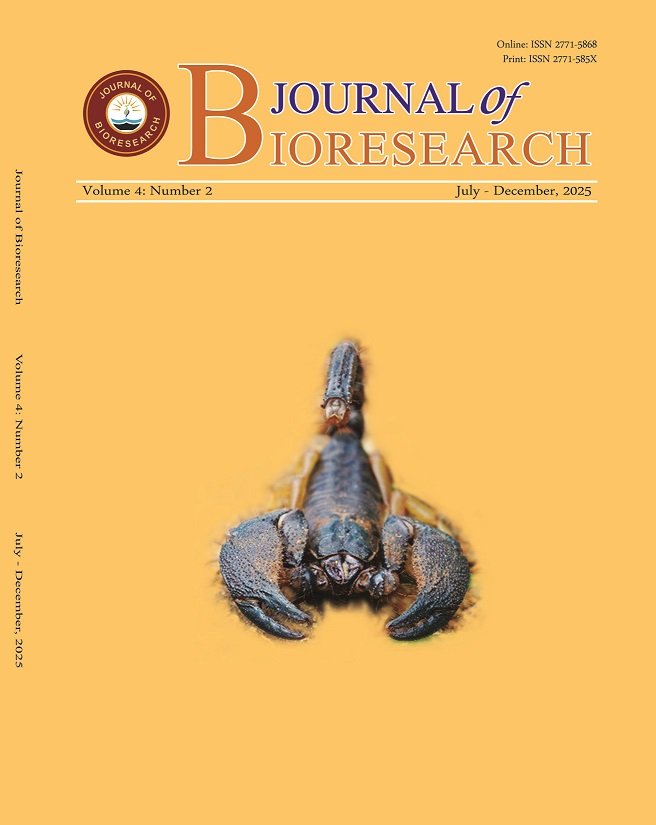
Abstract: Scorpions play a vital role in maintaining ecological balance, serving as both predators and prey and also play a significant role in biodiversity. This study explores the diversity, habitat preferences, and seasonal distribution of scorpions in the Kesanand-Wadebolhai region, located in eastern Pune, Maharashtra, India. A systematic survey was conducted between June 2023 and May 2024, focusing on five prominent scorpion species belonging to the families Buthidae (Hottentotta tamulus, Orthochirus bicolor) and family Scorpionidae (Heterometrus xanthopus, Heterometrus fulvipes and Deccanometrus phipsoni). The research employed active searching and pitfall trapping techniques to gather data on species richness, seasonal variations, population densities, and habitat associations. Statistical analysis was performed using the Shannon-Wiener and Simpson's diversity indices, with seasonal differences assessed through one-way ANOVA and correspondence analysis to identify habitat preferences. The results showed distinct seasonal patterns in species distribution, with the highest species richness recorded during the monsoon and post-monsoon seasons. Hottentotta tamulus and Orthochirus bicolor exhibited peak activity during the monsoon months, while Heterometrus fulvipes and Deccanometrus phipsoni were most active in the post-monsoon period. This study highlights the ecological roles of scorpions in semi-arid ecosystems and underscores the importance of their conservation amidst increasing habitat disruption caused by human activities. The findings provide crucial insights for future scorpion conservation efforts and contribute to a better understanding of their ecological dynamics.
Keywords: Habitat preferences; Kesanand-Wagholi; Scorpion diversity; Seasonal variability
Abstract: A biopesticide has been developed from Azadirachta indica A. Juss, Polygonum glabrum Willd., Cyclosorus parasiticus (L.) Farw., Curcuma longa L., Capsicum annum L. and cow urine to control insects and pests infestation on Citrus limon (L.) Burm f. (Assam lemon) grown at Kokrajhar district, BTR, Assam. Those five number of locally available medicinal plants selected for pesticide preparation were ground collectively into a fine paste using a mixer grinder along with distilled water. The paste was then sieved with a muslin cloth and squeezed to extract the solvent and diluted up to 200 ml. The resulting filtrate constitutes 50% stock solution later diluted into 1%, 5% and 10% and each solution has been mixed with 200 ml of cow urine before spray. The strength of aqueous extracts were evaluated by foliar spray on plants and their efficacy were determined for controlling the pests and diseases. Meanwhile four pest infested lemon trees were selected and tagged S1, S2, S3 and S4. Plant tagged as S1, S2 and S3 were considered for applying biopesticide @ 1%, 5% and 10% while S4 treated as a control plant. The said biopesticide of three different concentrations were sprayed once in a week from January 2024 to March 2025 with a hand sprayer (2L capacity). The biopesticide @10% (S3) concentration showed the best result with reduction of Diaphorina citri (Citrus psylla), Dialeurodes citri (white fly), Anoplophora versteegi (trunk borer), Phyllocnistis citrella (leaf miner) and other insect population as compared to the lemon plants - S1, S2 and S4.
Keywords: Biopesticide, <em>Citrus limon</em> (L.) Burm f., Disease, Insect, Pest and IPM